How to identify Colorado potato beetles!
Adults
- Oval in shape and 3/8 inch long
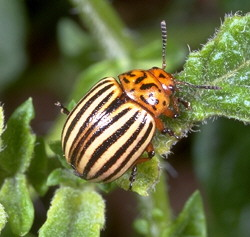
- Have a yellow-orange prothorax (the area behind the head) and yellowish-white wing covers with 10 narrow black stripes
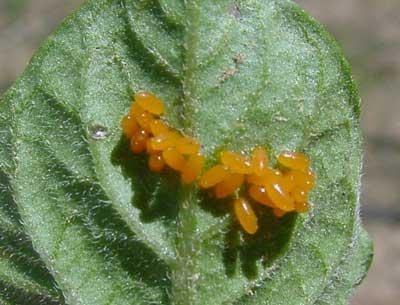
- Females lay clusters of bright yellowish-orange oval eggs on the underside of leaves
Biology of Colorado potato beetles
Plants they attack - Colorado potato beetles feed primarily on potatoes. They can also attack other plants in the nightshade family (Solanaceae), including:
- Eggplant
- Tomato
- Pepper
- Nightshade
- Ground cherry
Life cycle
Colorado potato beetle adults spend the winter 5-10 inches underground in fields, field margins, windbreaks, and gardens.
- Adults feed for a short time in the spring and then begin to mate and lay clusters of 10-30 eggs on the undersides of leaves.
- Each female can lay up to 350 eggs during her adult life which can last several weeks.
- Eggs begin to hatch within 2 weeks, depending upon temperatures.
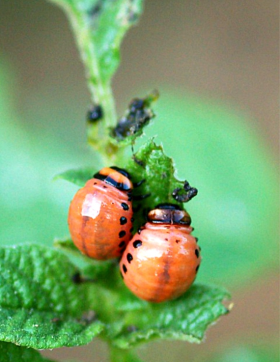
- Larvae cluster near the egg mass when young but begin to move throughout the plant as they eat the leaves.
- Larvae can complete development within 10 days if average temperatures are in the mid-80°F while it can take over a month if temperatures average near 60°F.
- The fourth instar larvae drop from the plant, burrow into the soil and transform into pupae.
How to protect your plants from Colorado potato beetles
Treatment of Colorado potato beetles in home gardens can be challenging. Use a combination of different pest management tactics to reduce Colorado potato beetle numbers.
- Keep your garden clean
- Plant early maturing varieties
- Pick beetles off plants
- Let natural enemies do their job
Using pesticides
Colorado potato beetles are resistant to essentially all synthetic pesticides like carbaryl, cypermethrin, deltamethrin, lambda-cyhalothrin, imidacloprid, permethrin, and pyrethrins. These products are unlikely to be effective and their use is not suggested.
Anytime you use a pesticide and it does not seem to kill Colorado potato beetles, switch to a different active ingredient.
Learn more from these Extension fact sheets: “Pests of Potato” from NC State Extension. For more information, contact Bryan Hartman, Agriculture and Natural Resources Agent at bkhartman@ncat.edu.