As with humans, plants must receive appropriate nutrients to grow. Most cattle, sheep, or goat operations rely heavily, if not completely, on forage production for feed. As fertilizer prices continue to climb, with urea (nitrogen), diammonium phosphate (phosphorus), and potash (potassium) prices nearly doubling since September 2020, now is the time to adopt new or different management practices.
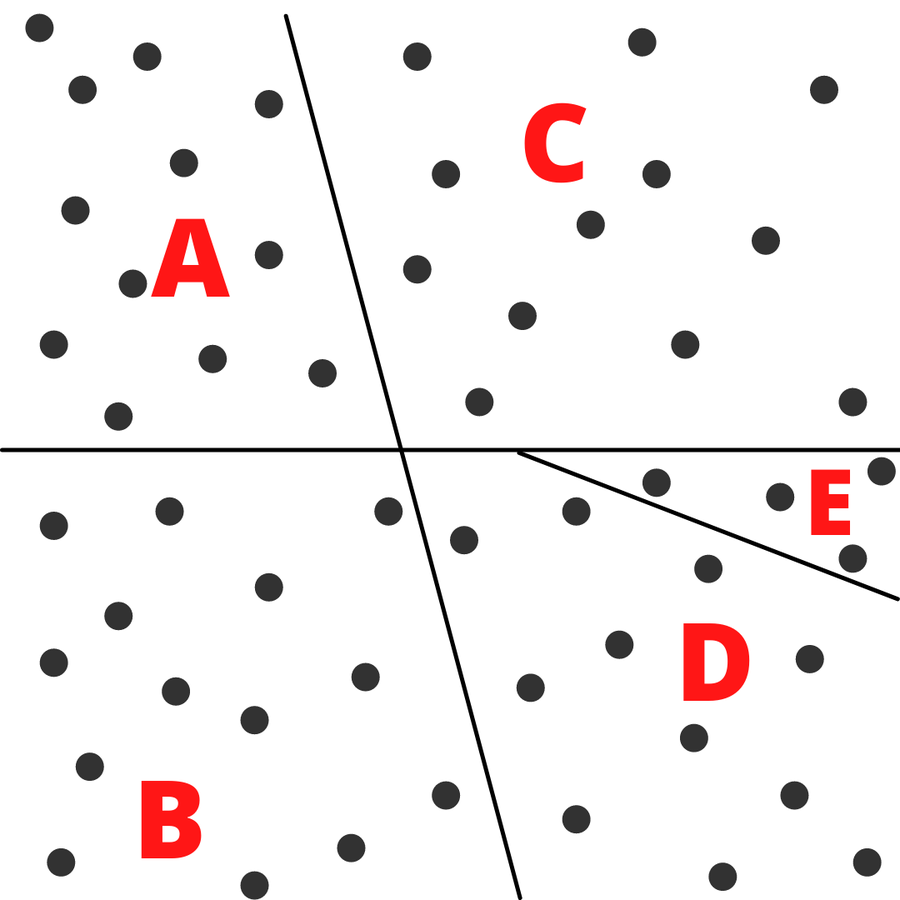
The best and easiest place to start when navigating this issue is taking a soil test. Soil testing at the NC Department of Agriculture and Consumer Services Agronomic Lab is $4/sample now through April. Samples submitted between April and Thanksgiving are free. Soil testing boxes and forms are available for free at the Cooperative Extension office in Danbury. The form can also be downloaded online. We also have a soil probe, which is used to make soil sampling easier. The recommended depth for soil sampling in pastures and hayfields is 4-6 inches. One representative sample should be submitted for each management zone. For example, consider the pasture layout below.
There are 5 pastures or hayfields in this example (A, B, C, D, and E). Each pasture is considered a management zone, so a total of 5 boxes would be submitted. The sample for each pasture is collected by taking a group of samples, or cores, from the pasture, which is represented by the dots on the map. Notice that cores are collected evenly throughout each area, and not in one corner or in a straight line. Collecting them randomly and throughout the entire area ensures that results are representative of the entire pasture or hayfield, instead of one corner or strip. As cores are collected in the pasture, they are placed in a clean, plastic bucket. After all cores are collected for pasture A, the soil will be mixed in the bucket. The mixed soil will be used to fill the sample box for pasture A, and the excess is discarded. This ensures that recommendations based on the sample are correct for the entire management area. The same steps are repeated for pastures B, C, D, and E.
The submission form for the example layout is linked below. In pasture or hayfield situations, the crop codes 055 or 054 are crop codes that will provide the most accurate amendment recommendations. Crop code 055 (tall fescue/orchardgrass/timothy, maintenance) should be used when the purpose of the sample is to improve or maintain existing pasture. Crop code 054 (tall fescue/orchardgrass/timothy, establishment) should be used when new pasture/hayfield is being newly established or planted. If you are not sure which crop code to use, listing both is the best option.
Samples should be addressed according to how they are mailed (there is a separate address for UPS/Fedex and USPS). The Extension office does not accept or mail samples.